Arshia Soltani Moakhar
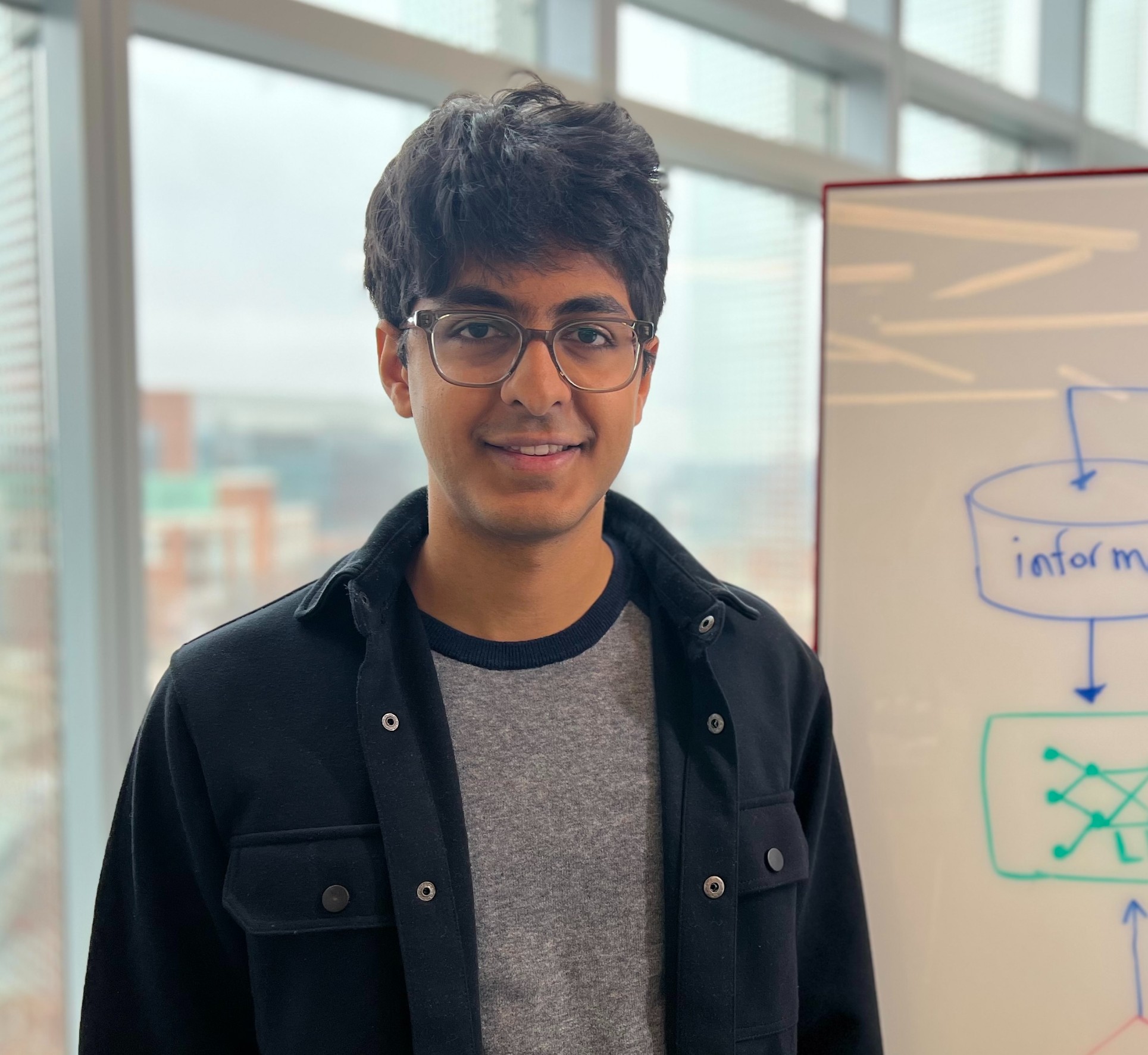
prof_pic2.jpg

I have wanted to be a researcher since middle school, fascinated by mathematical problems and intrigued by challenges. I pursued my interest further in high school by participating in the computer science olympiad, which led to my earning a silver medal in the International Olympiad in Informatics and participating in ICPC world final.

I also continued to nurture my algorithmic interests by joining the National Olympiad in Informatics committee as a member, contributing to the national olympiad in various capacities. These roles include, but are not limited to, serving as the summer camp principal graph lecturer (2021), leading the algorithmic problem design team for national team selection contests (2021, 2020), and heading the algorithmic problem design team for the national summer camp in informatics (2020, 2019).

Furthering my education, I majored in computer engineering and joined Dr. Rohban’s Lab. In this lab (Robust and Interpretable Machine Learning Lab), I published a paper in NeurIPS 2022 on adversarially robust Out-of-Distribution detection. This is not my only venture in the lab; you can read about some failed projects on the Project.

Since commencing my bachelor’s degree, I have been intrigued by Game Theory. To delve deeper, I completed various online and in-person courses, which further piqued my interest in Game Theory and Mechanism Design. Driven by my interest in both Game Theory and Machine Learning, I initiated a project within Dr. Rohban’s Lab focusing on these topics. This project aimed at aligning self-interested neurons in a neural network with a local utility function.

Additionally, during an internship at the Institute of Science and Technology Austria (IST Austria), I published a paper at ICML 2024 on the utilization of sparsity to enhance interpretability. Under the mentorship of Professor Dan Alistarh, this internship introduced me to the intriguing literature surrounding Sparsity and Interpretability, which I find very fascinating.

selected publications

  1. NeurIPS
    Your Out-of-Distribution Detection Method is not Robust! (NeurIPS)
    Mohammad Azizmalayeri, Arshia Soltani Moakhar, Arman Zarei, Reihaneh Zohrabi, Mohammad Taghi Manzuri, and Mohammad Hossein Rohban
    NeurIPS, 2022
  2. ICML
    SPADE: Sparsity-Guided Debugging for Deep Neural Networks. (ICML)
    Arshia Soltani Moakhar*, Eugenia Iofinova*, Elias Frantar, and Dan Alistarh
    ICML, NeurIPS ATTRIB workshop, 2024
  3. ICLR Spotlight
    INCLUDE: Evaluating Multilingual Language Understanding with Regional Knowledge (ICLR)
    Angelika Romanou, Negar Foroutan, Anna Sotnikova, Sree Harsha Nelaturu, Shivalika Singh, Rishabh Maheshwary, Micol Altomare, Zeming Chen, Mohamed A. Haggag, Snegha A, and 47 more authors
    In ICLR, 2025
  4. ICLR
    Software 1.0 Strengths for Interpretability and Data Efficiency (ICLR TinyPapers)
    Maral Jabbarishiviari, and Arshia Soltani Moakhar
    2024
  5. ICLR
    Kaleidoscope: In-language Exams for Massively Multilingual Vision Evaluation (ICLR)
    Israfel Salazar*, Manuel Fernández Burda*, Shayekh Bin Islam*, Arshia Soltani Moakhar*, Shivalika Singh*, Fabian Farestam*, Angelika Romanou*, Danylo Boiko, Dipika Khullar, Mike Zhang, and 34 more authors
    2025
  6. Failing to Explore: Language Models on Interactive Tasks (arXiv)
    Mahdi JafariRaviz*, Keivan Rezaei*, Arshia Soltani Moakhar*, Zahra Sodagar, Yize Cheng, and Soheil Feizi
    2026
  7. ICLR
    Active Learning for Decision Trees with Provable Guarantees (ICLR)
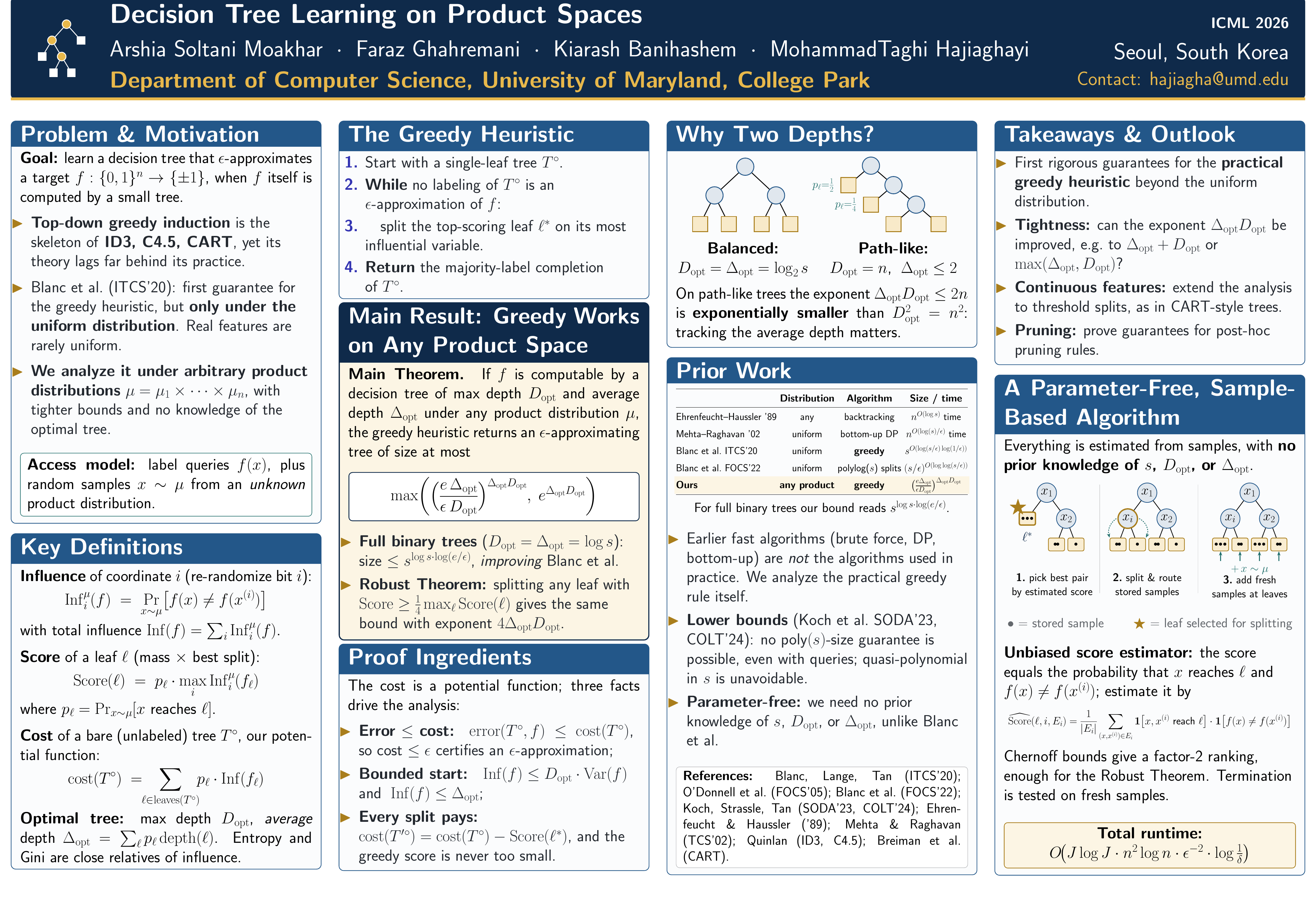
    Arshia Soltani Moakhar, Tanapoom Laoaron, Faraz Ghahremani, Kiarash Banihashem, and MohammadTaghi Hajiaghayi
    ICLR, 2026
  8. Your LLM Agents are Temporally Blind: The Misalignment Between Tool Use Decisions and Human Time Perception
    Yize Cheng*, Arshia Soltani Moakhar*, Chenrui Fan*, Parsa Hosseini, Kazem Faghih, Zahra Sodagar, Wenxiao Wang, and Soheil Feizi
    2026